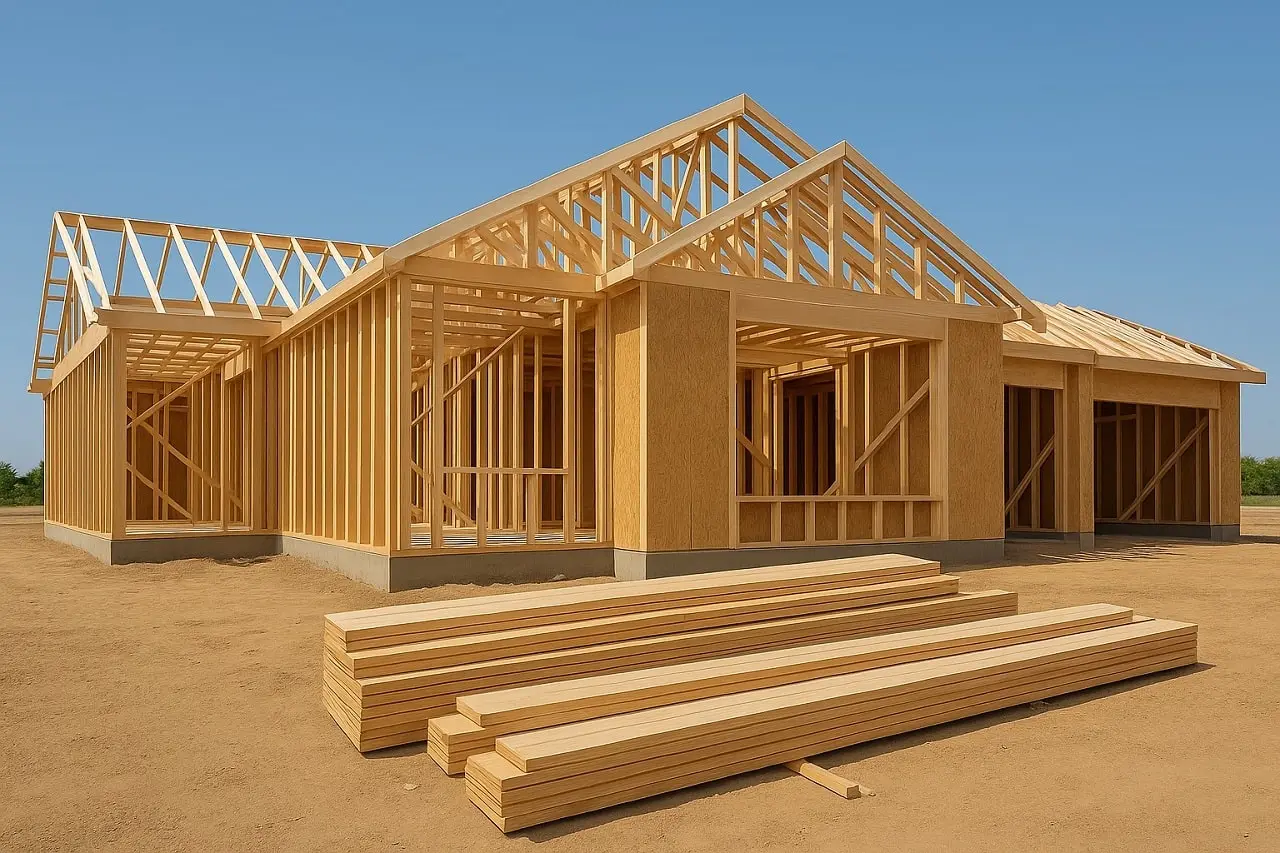
When Steve Martinez walks through a home that his company is building in Boise, Idaho, he points out an unavoidable reality: “This entire house is built out of wood,” he says. “Wood on the floor, wood on the wall, wood on the ceiling. Can’t really get away from building a house like this without using a large number of wood products.”
Martinez, president of Tradewinds General Contracting, builds high-end multifamily homes and apartments around 10 to 15 a year. But even in this small operation, volatility in lumber prices is causing serious disruptions. “One bunk of this material going up tenfold can cause a huge disruption from a price perspective,” he says.
And that disruption is not just local.
In April 2025, softwood lumber prices were 23% higher than the year before. Futures have surged as well, driven by fears of increased tariffs and sawmill closures across North America. Even some of the biggest names in homebuilding like Lennar, D.R. Horton, and Toll Brothers have seen their stock values dip in response.
Canada supplies about 85% of U.S. softwood lumber imports, making up nearly a quarter of total supply. And although lumber was excluded from the most recent round of tariffs, the Trump administration is considering new trade barriers. In March, the White House ordered the Commerce Department to review the national security impact of timber and lumber imports, calling them essential to manufacturing and national security.
“Lumber has always been the poster boy of tariffs,” says Martinez. “There’s already a lumber tariff in place for the Canadian side.” According to Martinez, these new tariffs would be in addition to an already existing tariff.
Currently, Canadian lumber faces a 14.5% duty, but that rate could more than double following an upcoming review.
Even as Washington calls for increased domestic production, Diana Olick, CNBC’s senior climate and real estate correspondent, points out that scaling up isn’t something that can happen quickly. “Right now, you can’t immediately scale up domestic lumber production in the U.S. in order to meet the demand,” she says.
That leaves builders like Martinez facing not only price volatility but a shrinking pool of options. He gestures to the exposed plywood: “This is OSB… it is literally used on the entire house. The whole roof… all the walls… all the floor.”
An average single-family home uses over 2,200 square feet of softwood lumber and 15,000 board feet of framing lumber. Wood is not only the skeleton of the home but also used in windows, doors, and cabinetry. And in Martinez’s case, contracts are often fixed-price. He mentioned that from the time they bid a project to the time they order material, prices could change drastically. “We’re trying to pre-order as much material as we can… The hard part is, where do you put that material?”
The majority of his lumber comes from Canada. The country is known for producing a significant amount of Spruce-Pine-Fir. Russ Taylor, a veteran in the forestry industry, says this type of wood is favored for being lightweight and easy to work with.
But supply chain issues aren’t limited to wood. The ongoing trade war with China is pushing up the cost of other building materials, from appliances and plumbing to vinyl flooring. Diana Olick notes: “These tariffs are only going to increase costs for builders, when builder costs were already rising.”
Martinez agrees: “There are thousands of products impacted by tariffs, From glass in the windows to the materials framing them.”
While the U.S. produces more than 64 million cubic meters of softwood lumber annually, it still falls short of demand. Regulations under the Endangered Species Act (ESA) and National Environmental Policy Act (NEPA) have also been blamed for slow domestic growth. The federal government hopes to streamline these processes, but results unfortunately will take years.
“We have got to reopen our national forests,” says Jim Tobin, president of the National Association of Home Builders. He said that they had to build capacity in the Southeast and Pacific Northwest.
That won’t be easy. Many domestic sawmills have been shut down for years and require significant investment to restart. Even if new mills are built, labor is another challenge. “We are needing more people,” says Martinez. He noted that more people were leaving the industry than entering, and remarked that immigration was sometimes viewed with unfair negativity.
Jobs in woodworking and logging are projected to decline through 2033. According to Taylor, finding skilled workers in sawmilling is difficult in both the U.S. and Canada. Stricter immigration policies further complicate the picture. Many physically demanding jobs, like pulling lumber from the “green chain”, are typically filled by immigrants. Now, fears of deportation are making it harder to retain this workforce.
Another shift is drawing lumber operations to the U.S. South, where energy costs are lower and regulations are looser. Nearly 38% of American lumber is now produced there, and Canadian companies are investing heavily in the region.
But for now, the U.S. still depends heavily on Canadian imports. That dependency, combined with rising demand and insufficient domestic production, keeps lumber prices high and the supply strained.
This article was based on a CNBC report on rising lumber prices and their impact on home building.